GAFA — 2026 International Symposium on Plastic Arts and Technological Media Education
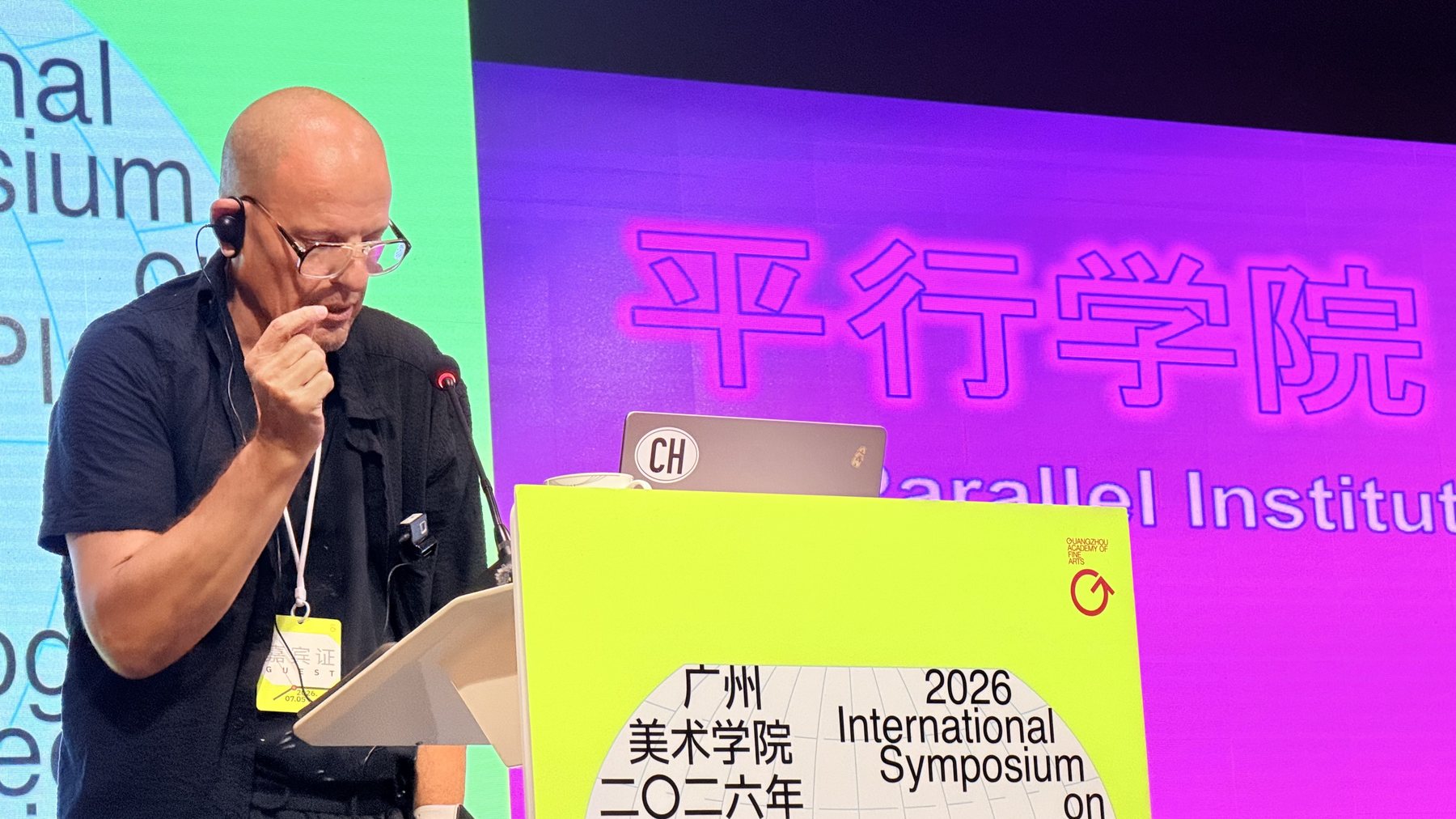
Luzius Bernhard delivering the Orchestration keynote, GAFA 2026, with the Parallel Institute slide behind him A Keynote by Luzius Bernhard · UBERMORGEN

Orchestration

编排

Art, infrastructure, and the conditions beneath the surface. Delivered at the 2026 International Symposium on Plastic Arts and Technological Media Education, Guangzhou Academy of Fine Arts, 5 July 2026.

艺术、基础设施,与表层之下的诸种条件。于2026年造型艺术与科技媒介国际教育研讨会宣讲,广州美术学院,2026年7月5日。

SpeakerLuzius Bernhard — UBERMORGEN / University Professor, Digital Arts Department, University of Applied Arts Vienna
SlotTopic 4 — Media Materials and Digital Art, 15:00–16:00
Length~10 minutes, about 1,395 words
CH. 00

Already Here

已然在场

They arrive first, and set the conditions our students work inside.

它们先行抵达,为学生设下工作的条件。

Good morning, and thank you to Guangzhou Academy of Fine Arts.

早上好,感谢广州美术学院的邀请。

Let me begin with an observation, not a warning. Something is changing in art education, and it is already here.

我想先陈述一个观察,而非发出警告。艺术教育正在发生变化,而这变化,已然在场。

Technological systems now shape attention, image, reputation, and authorship, before a student has made a single work. They arrive first, and set the conditions our students work inside.

技术系统如今塑造着注意力、形象、声誉与作者身份——早在学生完成第一件作品之前。它们先行抵达,为学生设下工作的条件。

Painting and sculpture are not in danger. But the conditions around them have changed, and our teaching has to meet them.

绘画与雕塑并未面临危险。但围绕它们的条件已经改变,我们的教学必须与之相遇。

CH. 01

The Surface Is Not the Enemy

表层,并非敌人

Much of the power now sits in the middle layer, almost never where an art school looks.

权力多半栖居于那道中间层,而这正是艺术学院最少察觉之处。

This symposium lives at the surface. Material, image, form, space.

这场研讨会栖居于表层:材料、图像、形式、空间。

So let me be clear. The surface is not the enemy. It is where deeper systems become visible. But if we teach only the surface, we teach the symptom and not the condition.

那么让我说清楚。 表层并非敌人。深层的系统正是在此显现自身。但若我们只教表层,我们教的是症状,而非条件本身。

Plastic arts education has always understood material conditions. What is new is the list of materials. Today it includes computational infrastructure: platforms, models, protocols, institutions.

造型艺术教育向来理解材料的条件。新的是材料的清单——今天,它包括了计算的基础设施:平台、模型、协议、机构。

Picture three layers. The surface, what we see. The machine room underneath: hardware, chips, models, energy. And between them a connecting layer, where systems are joined, coordinated, and governed. Much of the power now sits in that middle layer, and it is almost never where an art school looks.

试想三重层次。表层,是我们所见。底下是机房:硬件、芯片、模型、能源。二者之间,还有一层连接之层,系统在此被接入、协调、治理。权力多半栖居于那道中间层,而这正是艺术学院最少察觉之处。

Let me go down into it.

让我们向下走去。

CH. 02

The School Is the Artwork

学校,即为作品

The question is whether we design it on purpose, or run it on defaults.

问题在于,我们是刻意设计这一条件,还是任由它以默认设置运行。

I come to this as an artist. For thirty years I have worked in the collective UBERMORGEN. Our material has not been images. It has been networks, platforms, law, and the reactions of institutions. We work with systems the way another artist works with clay.

我以艺术家的身份来到这里。三十年来,我在UBERMORGEN这个团体中工作。我们的材料从来不是图像,而是网络、平台、法律,以及机构的反应。我们对待系统,如同其他艺术家对待陶土。

So let me state it plainly. The artwork is often not the image. It is the condition that produces the image. The condition that routes it, legitimises it, or turns it into money.

那么让我直言。 作品往往不是图像本身,而是催生图像的那个条件——是它被传播、被合法化,或被兑换为金钱的条件。

And it is not really about images. It is about products in general, and what produces them. In a school, the product is the student.

而这也并非只关乎图像,它关乎一切产品,以及产出它们的机制。 在一所学校里,产品就是学生。

Follow that all the way. If the artwork is the condition that produces the work, then the art school is the condition that produces the artist. It is not a neutral container for talent. It is the orchestrating layer, where rules, protocols, and aesthetics are developed, canonised, and turned into a status quo, and from there shape the art world beyond the school.

把这个逻辑推到底:如果作品是催生作品的条件,那么艺术学院就是催生艺术家的条件。它并非一个盛放天赋的中立容器,而是一层编排之层——规则、协议与美学在此被制定、被奉为经典、被固化为常态,并由此塑造校园之外的艺术世界。

So when I say the artwork is the condition, I include this room. The art school is itself an artwork. The question is whether we design that condition on purpose, or leave it running on defaults.

所以当我说作品即条件时,我把这间会场也算在内。 艺术学院本身,即是一件作品。问题在于,我们是刻意设计这一条件,还是任由它以默认设置运行。
CH. 03

Publish, Do Not Execute

只公开,不利用

The response of the system is the material.

系统的回应,即是材料。

Here is the method at the centre of what I want to say.

这里是我想说的核心方法。

An artist studies a real system until they find a real weakness. They describe, in public, exactly how it could be exploited. And then they do not exploit it. The proposal is published, credible, and deliberately left unexecuted.

艺术家研究一个真实的系统,直到找到它真正的弱点。他们公开地、精确地描述这个弱点将如何被利用——然后,不去利用它。方案被发表,可信,却刻意悬置,不予执行。

Now the institution has to respond. What it defends, what it quietly repairs, what it will not speak about: the response of the system is the material.

此刻,机构必须作出回应:它捍卫什么,悄悄修补什么,对什么保持沉默—— 系统的回应,即是材料。

The artist no longer has to guess how the system works. The system shows it, under pressure, in public. And the withholding is the discipline. The not-acting is the hardest and most precise part.

艺术家不再需要猜测系统如何运作,系统会在压力之下、在众目睽睽之中,自行显露。而这种克制,正是纪律所在。不去行动,是其中最艰难、也最精确的部分。

I know how this sounds in an art academy. Less like painting, more like a controlled experiment on a living institution. That is exactly what it is, and it may be one of the most important things an artist can now learn.

我知道这在艺术学院里听起来是什么——不太像绘画,更像是在一个活的机构之上进行的受控实验。而这,恰恰就是它的本质,也可能是艺术家如今能学到的最重要的事情之一。

CH. 04

Before It Locks

在它锁定之前

There is a window, while a foundational layer is still soft, still arguable.

尚有一扇窗:根基之层,仍然柔软,仍可争辩。

Now, acceleration. Not as drama, but as timing. The time between making, circulation, judgment, imitation, and extraction keeps compressing. Work is absorbed by systems that never pause.

现在,谈谈加速。这不是戏剧化的修辞,而是时间问题。创作、流通、评判、模仿与提取之间的间隔,正不断被压缩。作品被那些从不停歇的系统所吸纳。

But there is a second clock, and it matters more. The infrastructure we are discussing is being built right now. And infrastructure has a habit. Once it settles, it stops being a question and becomes a given. It locks. After that you can decorate its surface, but you can no longer touch its logic.

但还有第二重时钟,它更为关键。我们正在讨论的基础设施,此刻正在被建造。而基础设施有一种习性:一旦定型,它便不再是一个问题,而成为既定之物。它锁定了。此后,你可以装饰它的表层,却再也无法触及它的逻辑。

So there is a window, while a foundational layer is still soft, still arguable. Art can work in that window. It cannot work once the layer has hardened. We are teaching students for a condition that is still being decided, and it will not wait for them.

所以,存在着一扇窗口——趁根基之层仍然柔软,仍可争辩。艺术能够在这扇窗内工作,一旦这层硬化,便再无可能。我们正在为一个尚未被决定的条件培养学生,而这个条件,不会等待他们。

CH. 05

A Vibe with a Budget

有预算的氛围

Governance here is not paperwork. It is part of the artwork.

典章并非文书作业,而是作品的一部分。

There is a layer almost no lab or institute ever builds. Governance.

有一层,是几乎没有任何实验室或机构会去建造的——治理。

Each one needs rules of operation: how it remembers, who may act, what a student may refuse, how the rules themselves change. Not bureaucracy. Protocol. A constitution in the way a network has a protocol: agreements that let a system operate and be held accountable.

每一个系统都需要运行的规则:它如何记忆,谁可以行动,学生可以拒绝什么,规则本身又如何改变。这不是科层制度,而是协议——如同网络拥有协议:一组让系统得以运作、并可被问责的约定。

One sharp line, and then I move on. A lab without a constitution is only a vibe with a budget.

一句尖锐的话,说完便走。 没有典章的实验室,不过是一种有预算的氛围。

I say it so it stays with you. But it is serious. Build a lab with mood and equipment and no governance, and you leave the things that matter most, access, refusal, memory, responsibility, to chance. Governance here is not paperwork. It is part of the artwork.

我特意让这句话留在你心里,但它是认真的。若一个实验室只有情绪与设备而没有治理,你便把最重要的东西——准入、拒绝、记忆、责任——全部交给了偶然。典章并非文书作业,而是作品的一部分。

CH. 06

Not a Service Desk

实验室,不是服务台

Understood this way, it is an artwork, a curriculum, and a research instrument, at once.

如此理解,它同时是作品、课程,亦是研究的仪器。

At the Digital Arts Department in Vienna, which I run with lizvlx, we do not operate one lab. We run a distributed set of them. AI. Bio. 3D. Electronics. Sound. Investigative. Each with its own methods, running in parallel.

在维也纳的数字艺术系,我与lizvlx共同主持,我们运行的不是一间实验室,而是一组分布式的实验室:人工智能、生物、三维、电子、声音、调查性研究——各有其方法,彼此并行。

There are two ways to understand what a lab is for, and the difference is everything.

理解实验室的用途,有两种方式,而这两者之间的差异,就是一切。

In one, the lab is a service desk. A student arrives with a finished idea and uses the lab to fabricate it. The lab serves the project.

其一,实验室是服务台:学生带着一个已经成形的想法而来,利用实验室将其制作出来。实验室为项目服务。

In the other, the lab is a condition-producing system. It generates situations and questions that did not exist before the students walked in. Not what the student wants to make, but what situation we can compose together whose result none of us can predict yet.

其二,实验室是一套生产条件的系统。它生成的情境与问题,在学生走进来之前并不存在。重要的不是学生想做什么,而是我们能共同构建出怎样的情境——其结果,连我们自己都无法预知。

A lab understood this way is an artwork, a curriculum, and a research instrument, at once.

如此理解的实验室,同时是作品、课程,亦是研究的仪器。

CH. 07

The Pre-Experimental

前实验状态

Someone has to decide what can even be asked, and arrange a situation with no guaranteed outcome.

总得有人决定何为可问,并安排结果无法预知的情境。

This is what I most want to leave with you. I call it the pre-experimental.

这是我最想留给诸位的东西。我称之为——前实验状态。

We use the word experiment constantly in art schools. Often we give a student a tool, a brief, a deadline, and a fairly safe idea of the result. That is not experiment. That is execution wearing the costume of experiment.

在艺术学院里,我们不断使用"实验"这个词。但我们给学生的,往往是一件工具、一份简报、一个截止日期,以及一个相当安全、可预期的结果。 那不是实验,那是披着实验外衣的执行。

A real experiment needs conditions before it can have results. Someone has to decide what can even be asked, and arrange a situation whose outcome cannot be guaranteed.

真正的实验,需要先有条件,才谈得上结果。总得有人决定何为可问,并安排一种结果无法预知的情境。

That work comes before the experiment. It is pre-experimental. And it is almost never taught, because it cannot be graded in advance.

这项工作发生在实验之前——它是前实验的。而它几乎从未被教授,因为它无法被预先评分。

This is where a new model of art education lives. Not in newer tools; tools change every year. The lasting task is to teach students to build, arrange, and govern the conditions under which real experiments become possible.

新的艺术教育模式,正栖居于此。不在更新的工具里——工具年年更新。真正持久的任务,是教会学生去构建、安排并治理那些能够让真正的实验得以发生的条件。

CH. 08

The Parallel Institute

平行学院

An educational model, not a dream.

这是一种教育模型,而非一场梦想。

Let me turn to a pathway, because concepts need somewhere to land.

让我转向一条路径,因为概念总需要一个落脚之处。

I have brought a proposal to Guangzhou. I call it the Parallel Institute. It is not, first of all, a building. It begins with very little: a cluster of software agents, each a small semi-autonomous unit that reads, maps, generates, and tests. Parallel units, working together. From there it grows: physical labs, workshops, reused hardware, publications, exhibitions, exchange. Modest at the start, able to scale. An educational model, not a dream.

我为广州带来了一项提案,我称之为「平行学院」。它首先不是一栋建筑,而是从极少之物开始:一组软件智能体的集群,每一个都是微小的、半自主的单元,负责读取、绘图、生成与测试。诸多平行的单元,协同运作。由此生长出:实体实验室、工作坊、再利用的硬件、出版物、展览、交流。始于微末,却可扩展。这是一种教育模型,而非一场梦想。

And let me be careful, because this is where talks like mine usually go wrong. I am not carrying a finished idea from one place to set it down in another. What I am describing has no single origin. I am a reader of this work as much as an author of it.

请容我谨慎地说——这正是此类演讲最容易出错的地方。我并非把一个已经成形的想法从一处搬运到另一处安放。我所描述的,没有单一的起源。我是这项工作的读者,如同我也是它的作者。

We are standing inside the material that makes it concrete. Guangdong, the Pearl River Delta: one of the places on earth where these systems are actually designed and built, while the infrastructure of the near future is still soft.

此刻,我们正站在使之具体成形的材料之中。广东,珠江三角洲——这是地球上少数几个真正设计并制造这些系统的地方之一,而近未来的基础设施,此刻仍然柔软。

CH. 09

On Whose Terms

以谁之条件

The task is to teach them to build, question, and govern how art becomes possible.

更艰难的任务,是教会他们构建、质疑并治理艺术何以成立。

Let me end where this symposium begins, with symbiosis.

让我在这场研讨会开始的地方结束——以共生为名。

In biology, symbiosis is not always harmony. It includes dependency, tension, and sometimes one body living off another. Art and technology already coexist. The question is on what terms, and who gets to set them.

在生物学中,共生并不总是和谐:它包含依附、张力,有时是一方以另一方为食。艺术与科技,早已共存。 问题在于,以谁的条件共存,又由谁来设定这些条件。

So our task is not to teach students only to use technological media. Those tools they will learn quickly.

因此,我们的任务,不只是教会学生使用科技媒介——那些工具,他们会很快学会。

The harder task, and the better one, is to teach them to build, to question, to govern, and to reconfigure the conditions under which art becomes possible at all.

更艰难、也更值得去做的任务,是教会他们构建、质疑、治理,并重新配置那些使艺术得以成立的条件。

That is the pre-experimental. That is what a lab, a constitution, and an institute are for. And it is why I am glad to begin this, here, with you.

那就是前实验状态。那就是实验室、典章与学院存在的意义。也正因如此,我很高兴能在此地,与诸位一同开启这一切。

Thank you.

谢谢大家。

2026 International Symposium on Plastic Arts and Technological Media Education

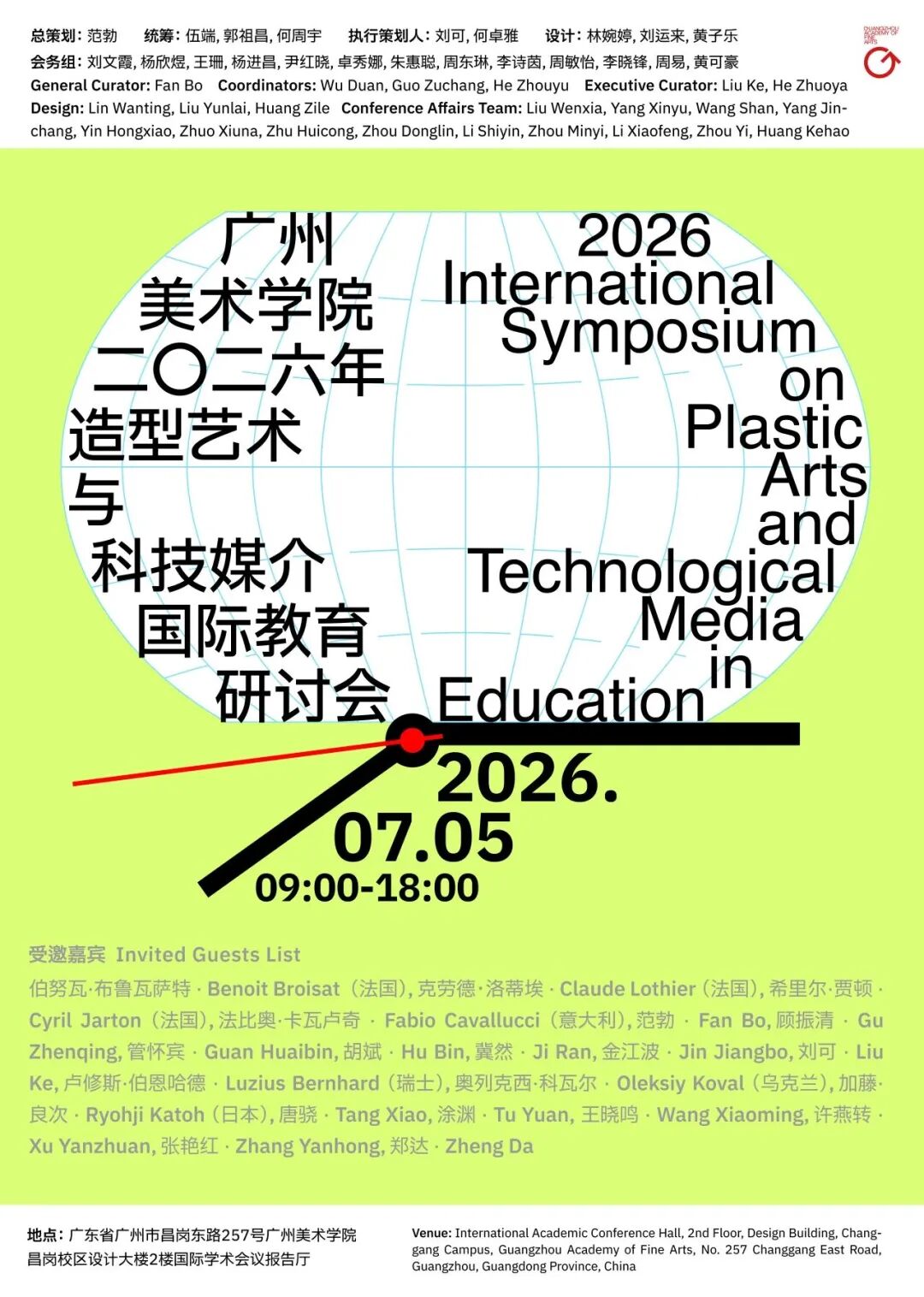
2026 International Symposium on Plastic Arts and Technological Media Education — official poster
Guangzhou Academy of Fine Arts, 5 July 2026. Over 20 experts and scholars from France, Austria, Japan, Italy, and China, across four topic sessions and two roundtables.
广州美术学院,2026年7月5日。来自法国、奥地利、日本、意大利及中国等国的20余位专家学者,分四场议题与两场圆桌论坛展开研讨。

Four Topics, Two Roundtables

09:20–10:20

Contemporary Art Education and Technology

当代艺术教育与科技
Fan Bo 范勃
President and Professor, Guangzhou Academy of Fine Arts
“Embodied Perception, Aesthetic Judgment, and Value Stance — Three Foundations of Plastic Arts Education in the Age of Artificial Intelligence”
Benoit Broisat 伯努瓦·布鲁瓦萨特
President and Professor, École Supérieure d'Art d'Avignon, France
“The Digital as Symbolic Form”
Ryohji Katoh 加藤·良次
President and Professor, Yokohama University of Art, Japan
“Art Education and Digital Technology at Yokohama University of Art”
Guan Huaibin 管怀宾
Professor, China Academy of Art; Director, Academic Committee, School of Intermedia Art
“Trans-experiential: The Path of Intermedia Art”
10:20–11:20

Artistic Vision and Ecological Coexistence

艺术视野与生态共域
Hu Bin 胡斌
Dean, School of Arts and Humanities; Curator and Professor, Guangzhou Academy of Fine Arts
“New Media Practices and Reflections of Young Chinese Artists in the Era of Digital Technology”
Fabio Cavallucci 法比奥·卡瓦卢奇
Curator; Professor, Academy of Fine Arts of Carrara, Italy
“Digital Curating: The Case of Institution”
Jin Jiangbo 金江波
Executive Dean and Professor, Shanghai Academy of Fine Arts, Shanghai University
“Digital-Intelligent Symbiosis: Exploring the Path of Innovative Development in Traditional Culture”
Gu Zhenqing 顾振清
Curator; Visiting Professor, Guangzhou Academy of Fine Arts
“Paradigm Shift in Contemporary Art”
14:00–15:00

Art Curation and Technology

艺术策展与科技
Claude Lothier 克劳德·洛蒂埃
Distinguished Professor, Guangzhou Academy of Fine Arts
“Perspective in Digital and Virtual Space”
Zheng Da 郑达
President and Professor, School of Fine Arts, Central China Normal University
“Agent-Oriented Artistic Practice”
Cyril Jarton 希里尔·贾顿
Professor, École Supérieure d'Art d'Avignon, France
“Restoration of Industrial Heritage and Its Artistic and Ecological Requalification Using Digital Tools”
Liu Ke 刘可
Professor and Vice Dean, School of Painting and Drawing; Director, Oil Painting Department, Guangzhou Academy of Fine Arts
“Pedagogical Pathways of the International Commons”
15:00–16:00

Media Materials and Digital Art

媒介材料与数字艺术
Tang Xiao 唐骁
Professor and Dean, School of Experimental Art, Hubei Institute of Fine Arts
“No Contradiction, No World — Artistic Practice Between Plastic Arts and Technological Media”
Oleksiy Koval 奥列克西·科瓦尔
Artist; Visiting Professor, Hubei Institute of Fine Arts
“Prediction Error as Distinction”
Xiaoming Wang 王晓鸣
Artist, Curator; Member, Japan Artists Association
“Art Creation Materials and Technology”
Luzius Bernhard 卢修斯·伯恩哈德
Professor and Director of Media Studio, University of Applied Arts Vienna, Austria
“Infrastructure, Acceleration, and the Pre-Experimental”
11:30–12:30

Juxtaposition and Symbiosis: Plastic Arts Education in the Age of Technological Media

并置与共生:科技媒介时代的造型艺术教育

Host — Liu Ke (刘可) — Vice Dean, School of Painting and Drawing, GAFA

Panel — Benoit Broisat, Fabio Cavallucci, Guan Huaibin, Gu Zhenqing, Jin Jiangbo, Ryohji Katoh, Tu Yuan, Xu Yanzhuan
16:10–17:30

Breaking Boundaries and Restructuring Ecosystems: How Is Technological Media Reshaping Plastic Arts Education?

破壁与重构:科技媒介如何重塑造型艺术教育生态?

Host — Ji Ran (冀然) — Assistant Researcher & Curator, New Art Museum Studies Research Center, GAFA

Panel — Claude Lothier, Cyril Jarton, Luzius Bernhard, Oleksiy Koval, Tang Xiao, Wang Xiaoming, Zheng Da, Zhang Yanhong

Closing remarks 17:30–17:50 — Guo Zuchang (郭祖昌), Dean and Professor, School of Painting and Drawing, GAFA.

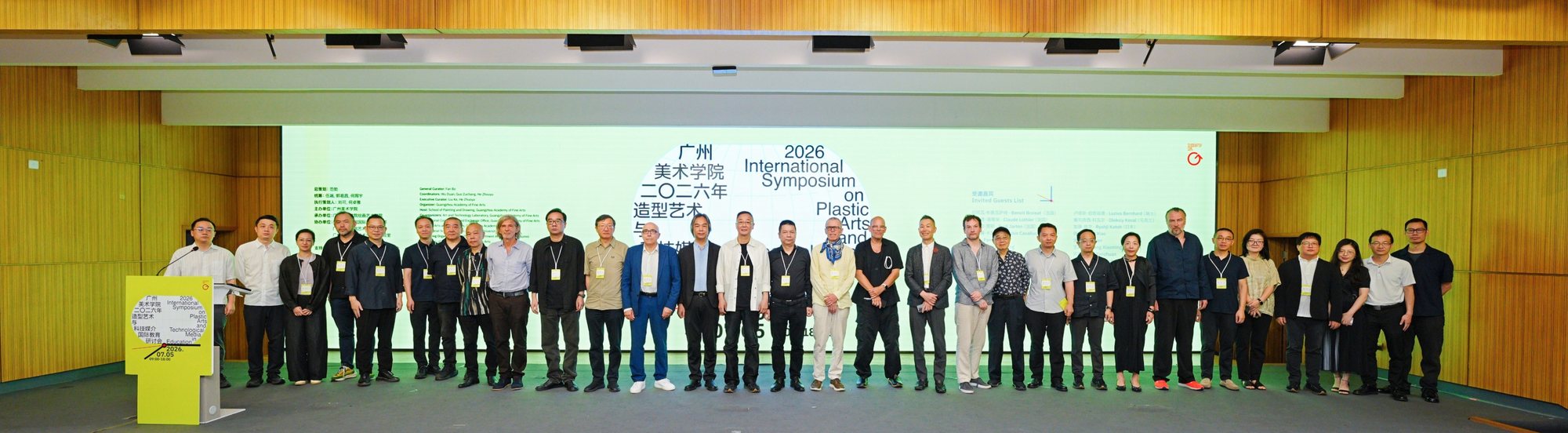
Speakers and panelists of the 2026 International Symposium on Plastic Arts and Technological Media Education, group photo on stage

Speakers and panelists, GAFA, 5 July 2026.